
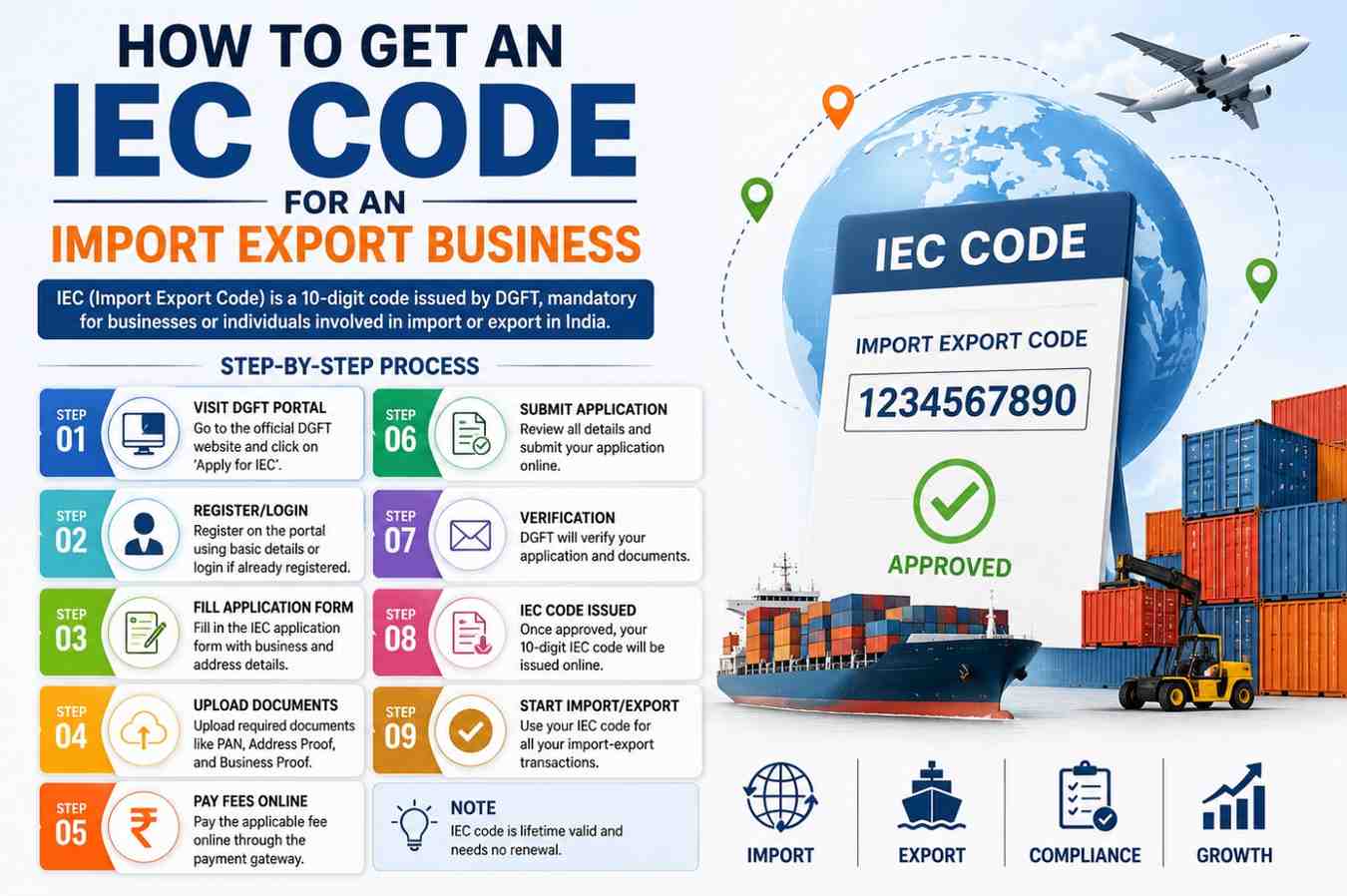
If you’re planning to enter international trade, obtaining an IEC Code for Import Export Business is one of the first and most important steps. Whether you want to export products from India or import goods from overseas, an Import Export Code (IEC) is mandatory in most cases. Issued by the Directorate General of Foreign Trade (DGFT), the IEC serves as a unique identification number for businesses involved in cross-border trade. In this guide, we’ll explain the complete process of obtaining an IEC Code for Import Export Business, the required documents, and the benefits of registration.
What Is an IEC Code?
An Import Export Code (IEC) is a 10-digit business identification number issued by the DGFT. Every individual, company, partnership firm, LLP, or proprietorship planning to engage in international trade must obtain an IEC Code for Import Export Business before importing or exporting goods and services.
Without an IEC, businesses may face difficulties in customs clearance, international payments, and export documentation.
Why Is an IEC Code Important?
Obtaining an IEC Code for Import Export Business is essential because it legally authorizes your business to conduct international trade. It also helps businesses receive export incentives and simplifies customs procedures.
Some key Benefits of IEC Code include:
- Legal authorization to import and export goods.
- Easy customs clearance.
- Ability to receive foreign currency payments.
- Access to government export promotion schemes.
- Lifetime validity with simple annual updates.
- Builds credibility with international buyers and suppliers.
These Benefits of IEC Code make it a mandatory requirement for businesses looking to expand globally.
Documents Required for IEC Code
Before starting the application, keep the following Documents Required for IEC Code ready:
- PAN Card of the individual or business entity.
- Aadhaar Card or other identity proof.
- Business address proof.
- Bank account details with a cancelled cheque or bank certificate.
- Email ID and mobile number linked with Aadhaar.
- Business registration documents (if applicable).
Having all the Documents Required for IEC Code prepared in advance helps ensure a smooth registration process.
IEC Code Registration Process
The IEC Code Registration Process is completely online and can usually be completed within a short time if all documents are available.
Follow these simple steps:
Step 1: Visit the DGFT Portal
Go to the official DGFT website and create a new user account using your business details.
Step 2: Fill Out the Application
Complete the online application by entering your business information, PAN details, address, and bank account information.
Step 3: Upload Required Documents
Upload all the Documents Required for IEC Code in the prescribed format.
Step 4: Pay the Registration Fee
Complete the online payment through the available payment gateway.
Step 5: Submit the Application
Review all the information carefully before submitting your application.
Step 6: Receive Your IEC
Once verified, your IEC Code for Import Export Business will be generated electronically and can be downloaded from the DGFT portal.
Following the correct IEC Code Registration Process ensures faster approval and avoids unnecessary delays.
How to Apply for IEC Code Online
Many entrepreneurs prefer How to Apply for IEC Code Online because it is quick, convenient, and paperless.
Here’s a quick summary:
- Register on the DGFT portal.
- Complete the online application form.
- Upload supporting documents.
- Pay the application fee.
- Submit the application.
- Download the approved IEC certificate.
Understanding how to apply for IEC Code Online helps new entrepreneurs complete the process without visiting any government office.
Common Mistakes to Avoid
While applying for an IEC Code for Import Export Business, avoid these common mistakes:
- Entering incorrect PAN or Aadhaar details.
- Uploading unclear or incorrect documents.
- Providing incorrect bank account information.
- Using an inactive email ID or mobile number.
- Not verifying all information before submission.
Avoiding these mistakes can speed up your Import Export Code Registration and prevent application rejection.
Who Needs an IEC Code?
Almost every business involved in international trade requires an IEC Code for Import Export Business, including:
- Manufacturers
- Traders
- Exporters
- Importers
- E-commerce exporters
- Service providers dealing with foreign clients
Whether you’re starting a small trading company or expanding an existing business, Import Export Code Registration is an essential legal requirement.
Get Expert Guidance Before You Apply
The registration process might look easy at first, but actually picking the proper business structure, getting clear on the compliance obligations, and putting together the export documentation can get tricky pretty fast, so it helps to have professional guidance. Looking for Business Counselling in India can save entrepreneurs from expensive missteps and help them set up a strong import export venture.
Also, joining Business Master Classes in Delhi gives hands-on insight into international trade, the paperwork side, buyer outreach, customs rules, and export approaches. In a way, it helps businesses expand with more confidence once they step into global markets.
Conclusion
Getting an IEC Code for your import export activity is usually the first step to building a solid international trading company. The online registration part feels pretty straightforward, as long as you actually have the right Documents Required for the IEC Code, and you stick to the IEC Code Registration Process in the right way. Once you understand how to apply for the IEC Code Online, you can save quite a bit of time, and you’ll be able to start importing or exporting sooner, without those annoying delays. And honestly, the Benefits of the IEC Code are hard to ignore, like legal compliance, easier customs clearance, and broader access to worldwide markets. So every new importer or exporter should do the Import Export Code Registration first, before jumping into any cross-border business.